

Most of what we are told about fertility concerns a small number of organs. The ovaries, the uterus, the testes. Investigations follow the same narrow path: follicles are counted, hormones are measured on particular days of the cycle, sperm are assessed for number and movement. None of this is misguided. These organs are, after all, where reproduction physically takes place, and the measurements taken from them are genuinely informative. Yet the effect of concentrating so completely on them is to give the impression that reproduction is a sealed compartment, a piece of machinery that either works or does not, largely independent of the body around it. This article is written to question that impression. Reproduction is a biological function, and like every other function the body performs, it can only proceed when certain conditions are met. The more revealing question, throughout, is not simply what an organ does, but what it requires in order to do it, and where those requirements come from.
Every organ has requirements before it has a function
It helps to begin by considering what an organ actually is. We tend to think of organs as objects, discrete pieces of anatomy with names and locations. It is more accurate to think of them as sites of continuous work. The kidney is filtering, the liver is processing, the thyroid is manufacturing and releasing hormones, and all of this is happening every second, without pause, for the whole of a life. Work of this kind is not something an organ simply does. It is something an organ is enabled to do, and only when the surrounding conditions permit.
Those conditions are surprisingly consistent from one organ to the next. Each needs a supply of oxygen and a blood supply to deliver it, along with the nutrients that circulation carries and the waste products it removes. Each depends on hormonal signals that tell it what to do and when to do it. Each requires energy produced within its own cells to power its activity, and enzymes to make its chemical reactions proceed at a useful speed. Each is regulated by the nervous and immune systems, and each needs protection from the oxidative damage that is an unavoidable by-product of being alive and metabolically active. These are not optional extras layered on top of function. They are the requirements that make function possible in the first place, and they lead to a principle that is worth stating plainly: an organ performs its specialised function because its biological requirements are being met. When they are met fully, function proceeds without strain. When they are met partially, function continues but under compromise. When they fail, function fails with them.
What differs between organs is emphasis. The brain consumes energy at a rate out of all proportion to its size and is exquisitely sensitive to any interruption in its fuel supply. The liver behaves more like a chemical plant, running thousands of reactions that depend on a steady flow of raw materials. The reproductive organs have their own particular demands, which we will come to. But the requirements themselves are not generated by the organ that needs them. They are supplied to it, from elsewhere in the body, and taken together they describe the conditions in which the organ is held. To ask why an organ functions poorly, then, is often less useful than to ask whether the conditions it depends upon are being maintained.
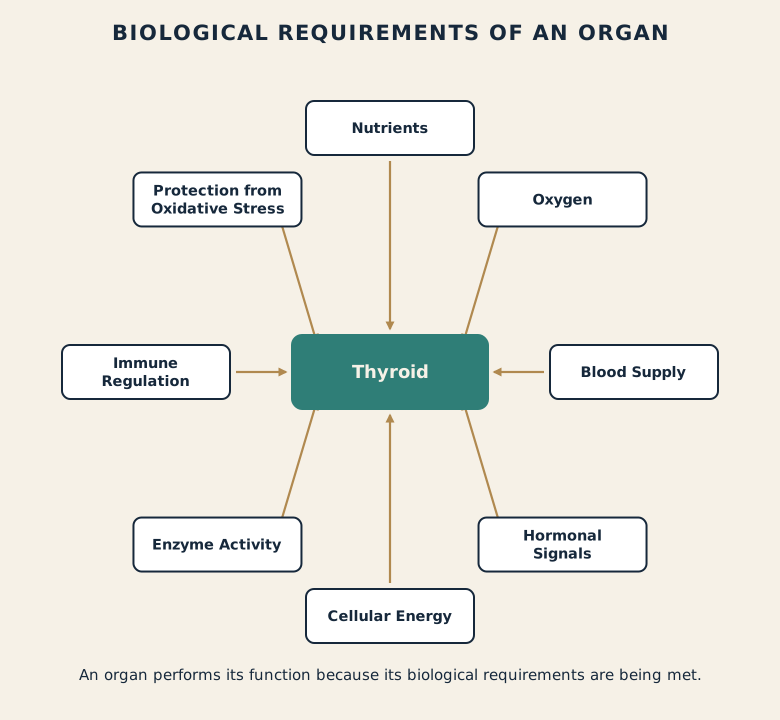
Figure 1. The biological requirements of a single organ. Each requirement is supplied from elsewhere in the body, and the organ performs its function only because these conditions are being met.
What nutrients actually do
The same reasoning applies to nutrients, though here a common habit of thought gets in the way. We are used to pairing individual nutrients with individual parts of the body, as though each had a single address. Calcium is for bones, iron is for blood, and so on. As shorthand this is harmless enough, but as biology it is misleading, because a single nutrient almost never has only one job. Magnesium participates in several hundred distinct enzymatic reactions across the body. Zinc contributes to immune defence, to wound repair, to the synthesis of DNA, and to the activity of numerous hormones. To say what a nutrient is “for” is to ask the wrong question.
A more accurate picture is one in which nutrients contribute to physiology in several different ways, and it is worth distinguishing between them, because the distinction does real work. Some nutrients contribute directly to function, forming part of the machinery that carries out a physiological task. Some support repair, providing the raw material from which tissues are rebuilt as they wear. Some are protective, defending tissues against the oxidative stress that metabolism continually generates. Some serve as cofactors, the small partners without which enzymes cannot work at all. Some are precursors, the substances from which hormones and other signalling molecules are constructed. And some are essential to the production of cellular energy itself, on which every other role ultimately depends. A single nutrient may occupy more than one of these categories at once, in more than one tissue, which is precisely why its absence is felt not in a single place but wherever it was quietly doing its work.
This shifts how we should think about nutrition. The value of a nutrient is not principally that it prevents a deficiency disease, in the way that too little vitamin C once caused scurvy in sailors. Overt deficiency states of that kind are now rare. The more relevant question is whether the body has enough of a given nutrient, in a usable form, to allow normal function and normal protection to proceed across all the many processes that quietly depend on it. Understood this way, nutrition is less about avoiding a named deficiency and more about keeping the body’s interior adequately provisioned, so that the organs drawing on it are never asked to work without what they require.
Systems that exist to support other systems
Once we accept that organs have requirements and that nutrients serve many roles, a further point follows almost inevitably. No organ meets its requirements alone, and the reason is structural rather than incidental. A great deal of the body is given over not to any headline function of its own but to supporting the function of everything else. The digestive system exists, in large part, to supply the raw materials that every organ requires. The circulation exists to transport those materials to where they are needed and to carry waste away. The liver processes and converts many of them into the forms the body can use. The endocrine system coordinates the timing and pace of activity across distant organs. The nervous system regulates the whole, adjusting it to circumstance. These are not organs that happen to be connected to others; they are systems whose principal purpose is to serve others. Only when these supporting systems have completed their work — the raw materials supplied, transported, processed, coordinated, regulated and protected — can a specialised organ turn to a function of its own.
Seen in this light, the interdependence of the body becomes something one can trace rather than merely assert. The thyroid gland is a useful example, because it is often discussed as though it were self-contained. In fact it relies on a considerable supporting cast. It needs iodine and the amino acid tyrosine to build its hormones, and selenium to handle them safely, but obtaining these depends on digestion breaking down food and the gut absorbing what is released. Once the thyroid has produced its principal hormone, it depends on the circulation to distribute it and on the liver and other tissues to convert it into its more active form, and on signals from the pituitary gland to govern the whole process. A thyroid can be structurally sound and still function poorly if any of these supporting systems falters.
The reproductive organs sit within exactly the same web of dependency, and are perhaps its most demanding beneficiary. Their activity is orchestrated by endocrine signalling that originates in the brain, sustained by nutrient availability, underwritten by metabolic stability, served by circulation to the pelvic tissues, and moderated by immune regulation, particularly at the delicate stage of implantation. What each of these supporting systems ultimately produces, between them, is a set of conditions: the state of the body’s interior in which any given organ is asked to work. It is this collectively produced state, rather than any single organ, that determines how well the whole performs.
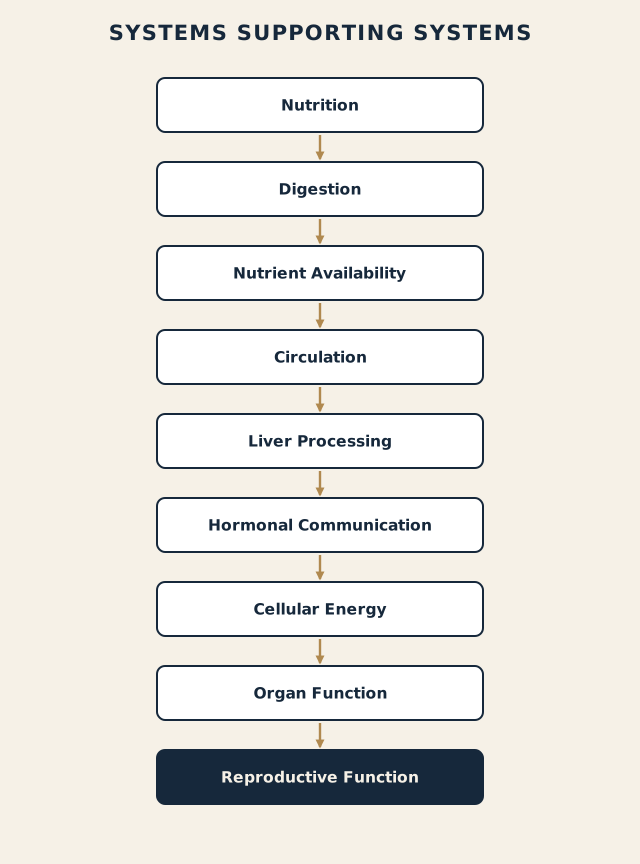
Figure 2. Systems supporting systems. A specialised organ can perform its own work only once the supporting systems — supplying, transporting, processing and coordinating — have completed theirs.
The difference between eating a nutrient and using it
There is a further distinction that matters a great deal and is easily overlooked. Consuming a nutrient is not the same as making it available to the cells that need it. Between the plate and the tissue lies a series of steps, and something can be lost at every one of them.
A nutrient must first be digested, broken down by stomach acid and digestive enzymes into a form the body can handle. It must then be absorbed, taken up across the lining of the gut, which requires that lining to be in reasonable working order. Once absorbed, many nutrients must be transported, often bound to carrier proteins that ferry them through the bloodstream to where they are required. Many then pass through the liver, which activates, converts, or packages them before they can be used. Finally, they must be taken up into the cells themselves, a process that depends on the right receptors and, frequently, on energy to drive it. This is not a smooth pipeline in which everything that enters at one end emerges at the other. It is a sequence of transformations, each of which can proceed well or badly.
The practical consequence is that two people eating an identical diet may end up with very different quantities of a nutrient actually reaching their tissues. What appears on a food diary records intake. What governs physiology is availability, the amount that survives the journey and arrives where it is needed in a usable form. This is one of the central ideas of the way I work, because it means that the provisioning of the body’s interior is not settled at the point of eating. It is settled by the systems that stand between the meal and the cell: the digestive tract, the liver, the transport machinery, the cellular uptake. Nutrition cannot be judged by food alone, because availability is a property of the internal environment, not of the diet.
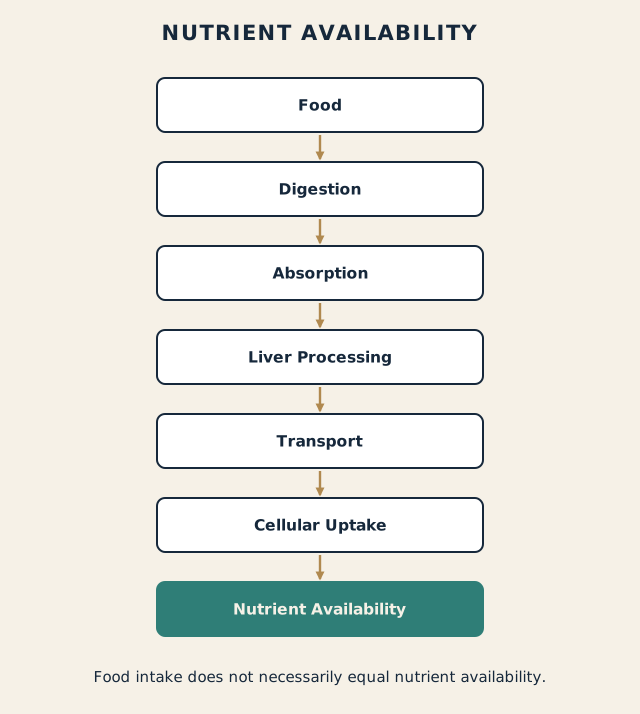
Figure 3. The journey from food to nutrient availability. Something can be added or lost at every stage, which is why what is eaten and what reaches the cell are not the same thing.
The internal environment
All of this points towards a concept that predates modern biochemistry by more than a century, and which the preceding sections have really been circling. In the nineteenth century the French physiologist Claude Bernard observed that the cells of the body do not live in the outside world at all. They live bathed in the fluids of the body, in what he called the milieu intérieur, the internal environment. He proposed that the stability of this internal environment was the condition of a free and independent life, and that an organism’s real achievement was not adapting to the world outside but maintaining constancy within. The idea was later refined into the principle of homeostasis, the body’s tendency to hold its internal conditions steady.
Bernard’s insight gives a name to the thread running through everything so far. Every organ functions within this internal environment, and its performance is shaped by the environment’s qualities: its temperature, its acidity, the concentration of sugar in the blood, the balance of hormones, the availability of oxygen, the level of background inflammation. The requirements an organ depends upon are simply the local expression of this environment being in good order. A structurally healthy organ placed within a disturbed one cannot function well, in much the same way that a well-built engine will run poorly on a contaminated fuel supply, however sound its own construction. This is a subtle but consequential reframing of what health means. It suggests that the more searching question is rarely what is wrong with a particular organ, but whether the internal environment it inhabits is capable of supporting its normal work. Function is a product of both, and the environment is the part we most often overlook.
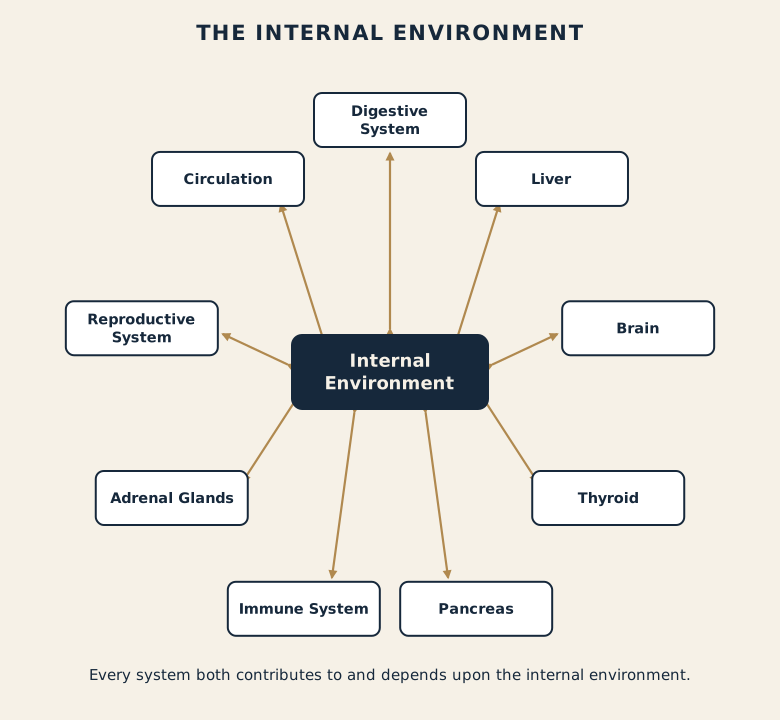
Figure 4. The internal environment. Every major system both contributes to the internal environment and depends upon it, which is why no organ can be understood in isolation from the rest.
The body decides what to fund
The internal environment is not limitless, and this leads to a principle that is easy to state and easy to overstate, so it is worth putting carefully. The body works with finite resources, and it is engaged in a continual act of allocation, distributing what it has according to what matters most at any given moment. When resources are ample, that allocation is generous and few functions go short. When they are constrained, the body does not distribute them evenly. It prioritises, and the functions essential to immediate survival, keeping the heart beating, the brain supplied, the breath moving, take precedence over functions that can, biologically speaking, afford to wait.
Reproduction is one of the functions that can wait, and it is also among the most expensive the body ever undertakes. The maturation of a single healthy egg is the endpoint of months of preparation. The continuous production of sperm proceeds in enormous numbers and is metabolically costly. The preparation of the uterine lining, the establishment of a pregnancy, and its maintenance over many months all draw heavily on the body’s reserves. Given the scale of this investment, it is unsurprising that reproduction is supported most fully when the internal environment is in a position to support it, and supported less readily when that environment is under strain. This should not be inflated into a claim that difficulty or stress simply switches fertility off, which would be too crude to be true. It is better understood as a matter of allocation. Reproduction proceeds most readily when the body has resources to spare, and the state of the internal environment is what determines whether it does.
What this means for fertility
We can now draw these threads together. If organs function only when their requirements are met, if nutrients serve many functional and protective roles, if whole systems exist to supply and coordinate the rest, if availability is decided after eating rather than at it, and if the body allocates its finite resources according to the state of its interior, then fertility cannot sensibly be regarded as a purely reproductive matter. It is better understood as a reflection of how well the internal environment is being produced and maintained by the many systems that contribute to it.
Nutrition, digestion, metabolism, sleep, stress and recovery, hormonal communication, immune regulation, and cellular energy all have a bearing on reproductive health. It is important to be precise about the nature of that bearing. These systems are not, in most cases, the cause of infertility in any simple, direct sense, and it would be wrong to present them that way. Rather, each contributes to the internal environment within which reproduction takes place, and it is the quality of that environment, not the sum of the parts in isolation, that reproductive physiology depends upon. Reproductive health, on this view, sits downstream of the internal environment, and rises or falls with it. This does not dismiss the reproductive organs or the value of proper medical investigation. It places them in their true context, as the visible end of a physiology that reaches through the whole body.
The Restoration Model
It was this line of reasoning that led me to develop the Restoration Model. After years of working with clients, I found myself increasingly drawn away from the individual symptom or diagnosis and towards the biological systems that stand behind it, the systems that determine whether the body’s interior is well provisioned, well regulated, and well supported. It seemed to me that these systems were rarely assessed together, as a whole, even though they function as a whole. The Restoration Model was developed as a framework for doing exactly that: for examining the major systems that produce the internal environment, and for supporting them in concert rather than one symptom at a time.
For the same reason I developed the Restoration Assessment. I wanted a way of evaluating the major systems that contribute to the internal environment, rather than concentrating on symptoms in isolation, so that the conditions underlying function could be understood rather than assumed. The assessment exists because the questions that matter most are frequently the ones a narrow focus never thinks to ask: not only what is happening, but what the systems responsible require in order to work as they should.
The model itself rests on five pillars, and it will be clear by now that these are not five separate projects but five aspects of one underlying aim. The first is to restore nutritional status, ensuring that the raw materials the body depends upon are genuinely present and available, not merely eaten. The second is to rebuild digestive function, because absorption is what turns intake into availability, and the digestive system stands at the gateway of everything that follows. The third is to stabilise metabolic function, since steady energy production and steady blood sugar form the foundation on which more demanding processes can be built. The fourth is to regulate stress and recovery, recognising the nervous system’s role in how the body allocates its resources and carries out its repair. The fifth is to maintain consistency, because physiology responds to conditions that are sustained over time rather than to occasional or dramatic effort. Together these pillars address the major systems that produce and maintain the internal environment, which is why they are approached as a whole rather than in isolation.
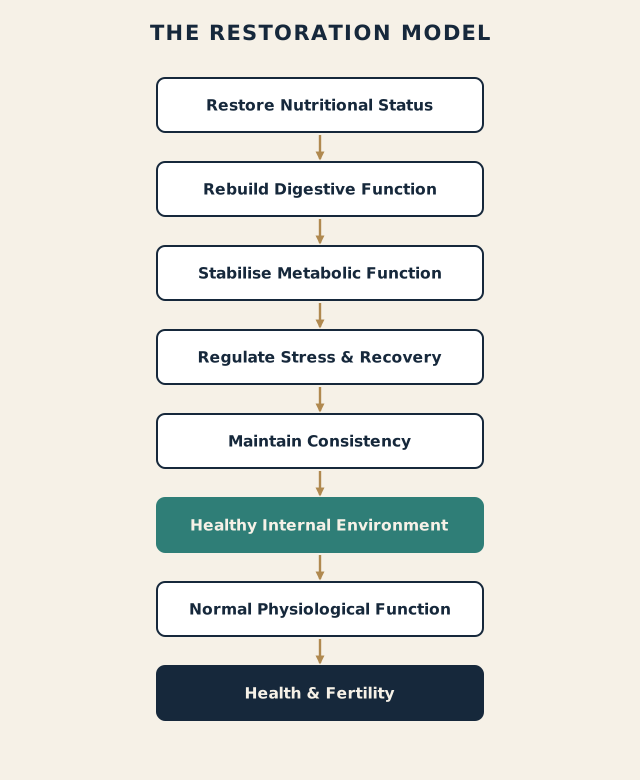
Figure 5. The Restoration Model. The five pillars work together to support a healthy internal environment, within which normal physiological function — and with it health and fertility — can proceed.
A different way of seeing the body
Fertility is rarely about one organ, one hormone, or one diagnosis. It is about the internal environment in which normal physiology is able to occur, and that environment is built and maintained by systems that reach far beyond the reproductive organs themselves. The ovaries, the uterus, and the testes work as the visible end of a long chain of physiological support, and their performance reflects the state of that chain as much as anything intrinsic to them.
The change this asks of us is a change in the question we put to the body. For a long time the instinct has been to ask what a given organ does, and what has gone wrong with it. The more revealing question — and the one on which the Restoration Model is founded — is not what an organ does, but what it requires in order to perform its normal biological function, and whether the rest of the body is at present able to provide it. Asked the first way, the body appears as a collection of separate parts, each to be examined and corrected on its own. Asked the second, it resolves into something quite different: a single internal environment, produced and sustained by every system at once, in which each organ rises or falls with the conditions that surround it. Fertility, in the end, is not the possession of any one organ. It is what becomes possible when the whole body is well enough to allow it.