
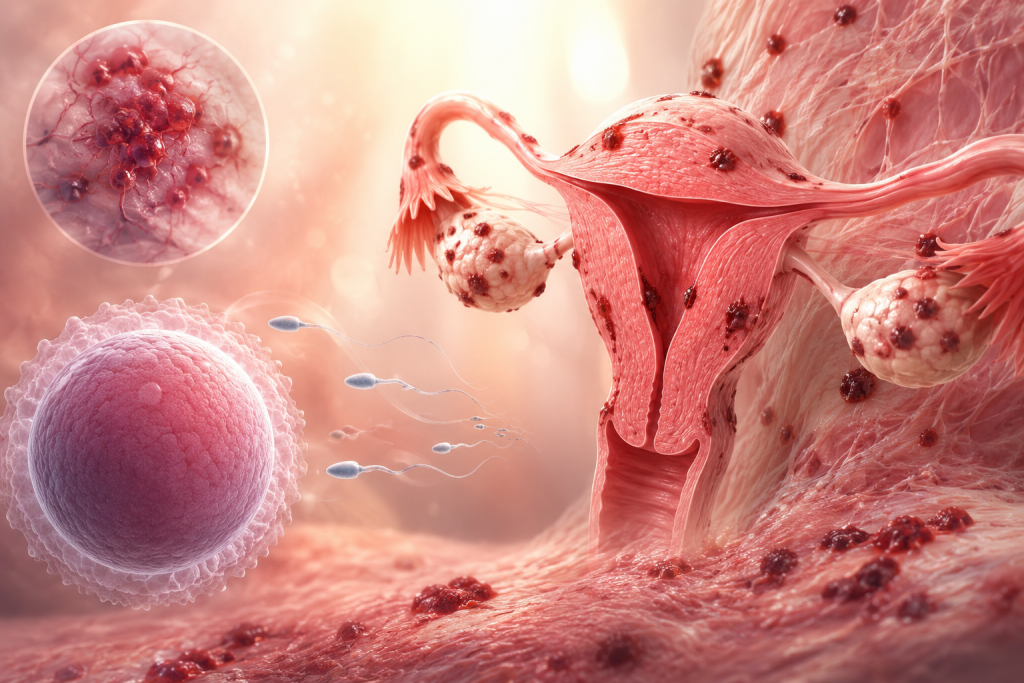
Endometriosis may affect fertility in several ways, including inflammation, adhesions, ovarian function, egg quality and hormone regulation. Understanding these mechanisms, alongside the wider health of the body, can help you better understand your fertility journey and the factors that support reproductive health.
Receiving an endometriosis diagnosis can stir up a great deal of emotion, especially when you are hoping to start or grow a family. You may have spent years searching for an explanation for your symptoms, only to be handed a diagnosis that raises just as many questions as it answers. What does this mean for my chances of conceiving? Will I need IVF? Is there anything I can do to support my body? It is completely understandable to feel overwhelmed.
The first thing worth saying is this: a diagnosis of endometriosis does not automatically mean you will struggle to conceive. Many women with endometriosis go on to have healthy pregnancies, some naturally and some with medical support. For others, the condition does appear to influence several aspects of reproductive health. Understanding how and why can help you feel more informed, more in control, and better able to make decisions alongside your medical team.
A diagnosis tells us what the condition is. It doesn’t always explain why one woman with endometriosis conceives naturally while another struggles for years. That is because fertility is influenced by far more than one diagnosis alone. It is influenced by the health of the entire reproductive environment and the many systems that support it.
This article explains, in plain English, how endometriosis may affect fertility, and why supporting your whole body, rather than focusing on a single diagnosis, matters so much.
What Is Endometriosis?
The lining of the womb is called the endometrium. Each month it thickens in preparation for a possible pregnancy, then sheds during a period. Endometriosis is a condition in which tissue similar to this lining grows in places outside the womb, such as on the ovaries, the fallopian tubes, the bladder, the bowel, and the surrounding pelvic area.
This misplaced tissue still responds to the monthly rise and fall of hormones. It can thicken, break down and bleed, but unlike a normal period, it has no easy way to leave the body. Over time this can lead to inflammation, pain, and in some cases the formation of scar tissue.
Endometriosis is common, affecting roughly one in ten women of reproductive age, yet it remains widely misunderstood. The severity of symptoms does not always match what is found inside the body. Some women have extensive endometriosis with few symptoms, while others experience significant pain with relatively little visible disease.
Why Do Some Women Conceive Naturally While Others Find It Harder?
This is one of the most important and most reassuring points to understand. Endometriosis exists on a spectrum, and so does its effect on fertility.
For some women, the condition has little measurable impact on their ability to conceive. For others, it may influence the pelvic environment, the ovaries, the fallopian tubes or the uterus in ways that make conception more challenging. Two women with the same diagnosis can have very different experiences.
Because of this variation, there is rarely a single, tidy explanation. Instead, it helps to look at the different ways endometriosis may affect reproductive health, while remembering that not every factor applies to every woman.
How Inflammation May Influence the Pelvic Environment
Inflammation is one of the central themes in the relationship between endometriosis and fertility. When endometriosis tissue bleeds and breaks down, the body responds with inflammation. This is a normal defensive process, but when it becomes persistent, it can alter the local environment within the pelvis.
The fluid that naturally surrounds the reproductive organs can become richer in inflammatory substances. This changed environment is one of the ways inflammation and fertility are thought to be connected, because the egg, sperm and early embryo are all sensitive to the conditions around them.
Think of inflammation like smoke after a fire. The smoke isn’t always the original problem, but it changes the environment around it. In the same way, persistent inflammation may influence the environment surrounding the ovaries, fallopian tubes and uterus. Fertility depends not only on healthy eggs and sperm, but also on the environment in which they meet and develop.
Effects on the Ovaries, Fallopian Tubes and Uterus
A more inflamed pelvic environment may affect reproductive function in several subtle ways. Around the ovaries, inflammation may influence the delicate process of egg development and release. Within the fallopian tubes, where the egg and sperm normally meet, inflammation and structural changes can affect how freely the tube is able to move and transport an egg. Within the uterus, a less settled internal environment may, in some cases, influence how receptive the lining is.
None of these effects is guaranteed, and many women conceive despite them. But they help explain why endometriosis is sometimes associated with reduced fertility.
The Role of Scar Tissue and Adhesions
When inflammation persists over time, the body may lay down scar tissue. In some women this leads to adhesions, which are bands of fibrous tissue that can cause organs to stick together that would normally move independently.
In the pelvis, adhesions can affect the position and mobility of the ovaries and fallopian tubes. If a tube becomes distorted or partially blocked, it may struggle to pick up and transport an egg. This is one of the more mechanical ways in which endometriosis can influence fertility, and it is part of the reason some women are advised to consider surgical or assisted options such as IVF.
Ovarian Endometriosis, Ovarian Function and Egg Quality
In some cases, endometriosis forms cysts on the ovaries, sometimes called endometriomas. Because they sit within the ovary itself, they can affect the surrounding ovarian tissue.
Researchers are still building a full picture, but ovarian endometriosis may influence both the number of eggs available and, potentially, egg quality. Egg quality is a phrase you will hear often on a fertility journey. In simple terms, it refers to how healthy and well-equipped an egg is to be fertilised and develop into a healthy embryo.
It is worth holding this gently. Egg quality is influenced by many factors across the whole body, not by endometriosis alone, which is exactly why a broader, whole-body view is so valuable.
Hormone Regulation, Explained Simply
Hormones are chemical messengers that coordinate the menstrual cycle, ovulation and the preparation of the womb for pregnancy. Good hormone balance is essential for fertility, and endometriosis is closely tied to the way the body responds to hormones, particularly oestrogen.
Here is a point that is often missed. Hormone balance is not only about how much of a hormone your body produces. It is also about how well your body processes and clears hormones once they have done their job. Your liver and digestive system play an important role in breaking down and eliminating used hormones so that levels stay within a healthy range.
Hormone balance is a continuous cycle. Hormones are produced, used by the body, broken down and then removed. Each stage relies on different systems working efficiently. If one part of that process is under strain, it may affect overall hormone regulation. This doesn’t mean it is the cause of endometriosis, but it reminds us that hormone health is about much more than production alone.
If this process is not functioning as efficiently as it should, hormone regulation may be affected. So when we talk about supporting hormone balance, we are really talking about supporting the whole cycle of producing, using and removing hormones, not just one half of the equation.
The Possible Role of the Immune System
The immune system is your body’s defence and clean-up service. In endometriosis, researchers believe the immune system may behave differently, which could affect how the misplaced tissue is recognised and managed, and how inflammation is regulated.
In plain terms, an immune system that is working in a more balanced way tends to support a calmer internal environment. While this is still an area of active research, it is another reminder that fertility is shaped by systems working together rather than by any single organ.
Implantation: One Possible Factor, Not a Certainty
Implantation is the moment an early embryo settles into the lining of the womb. Some research suggests that, in certain women, endometriosis-related inflammation or changes in the womb lining may influence how readily implantation occurs.
It is important to frame this carefully. This is one possible factor among many, not an inevitability. Plenty of women with endometriosis implant and carry pregnancies without difficulty. Understanding implantation simply adds another piece to the puzzle, rather than offering a definitive answer.
Fertility Is Not Determined by One Organ Alone
If there is one message to take from all of this, it is that fertility is never about a single organ or a single diagnosis.
The ovaries do not work in isolation. The uterus does not work in isolation. Every reproductive organ depends on nutrients, energy, blood flow, hormone signalling, immune regulation and communication with the rest of the body. Fertility is ultimately a whole-body process.
When we focus on only one organ, we risk overlooking the wider systems that help support reproductive health every single day.
This is a more hopeful way to look at things. While you cannot change your diagnosis, there are many aspects of your overall health that influence the environment in which reproduction takes place.
The Body Systems That Work Together
Several everyday systems quietly support reproductive health. Nutrition provides the raw materials your body uses to build hormones, eggs and healthy tissue. Digestion affects how well you absorb those nutrients and, as we have seen, how effectively you clear used hormones. Metabolic health and blood sugar regulation influence energy, inflammation and hormone signalling throughout the body. Sleep is when much of the body’s repair and hormonal housekeeping takes place. Stress and recovery affect the hormonal balance that governs the menstrual cycle. And hormone regulation ties all of these together.
None of these systems causes endometriosis, and supporting them is not a treatment for it. Rather, they contribute to your overall health and may help create a more balanced internal environment, which is a sensible foundation whether you are trying to conceive naturally or preparing for IVF.
Imagine trying to grow a beautiful garden. You wouldn’t only look at the seed. You would look at the quality of the soil, the amount of sunlight, the water supply and the surrounding environment. Fertility is very similar. The egg is important, but so is the environment in which it develops, travels and implants. Supporting that environment is an important part of supporting fertility.
A Whole-Body Approach to Fertility
This philosophy sits at the heart of my Restoration Model.
Rather than looking at fertility through the lens of one diagnosis alone, I look at the systems that support reproductive health.
Nutrition.
Digestion.
Metabolic health.
Hormone regulation.
Sleep.
Stress and recovery.
Movement.
These systems do not work independently. Every system influences the next. Digestion affects nutrient availability. Nutrients help support hormone production. Hormones influence ovulation. Sleep affects hormone signalling. Stress influences immune regulation. Together, these systems help create the internal environment in which fertility takes place. When they function well together, they help create the best possible environment to support reproductive health.
This is not about promising a cure for endometriosis. It is about understanding that fertility is influenced by much more than one diagnosis and recognising the value of supporting the body’s interconnected systems alongside appropriate medical care.
A Final, Encouraging Word
Endometriosis may be one chapter of your fertility journey, but it does not define the whole story.
While no single approach is right for everyone, understanding how your body’s systems work together gives you a stronger foundation for making informed decisions. By supporting your overall health alongside appropriate medical care, you are helping to create the best possible environment for fertility.
If you would like to explore a calm, systems-based approach to supporting your body throughout your fertility journey, you are warmly invited to learn more about Jonathan Jackson’s Restoration Model and his whole-body approach to fertility support.
A diagnosis may explain what the condition is, but understanding your body helps you understand what may be influencing it. My aim is to help people see the bigger picture, because fertility is rarely about one organ, one symptom or one diagnosis. It is about supporting the body as the remarkable interconnected system it was designed to be.